
The National Association of Homebuilders Fighting to Advance Canadian Interests to the Detriment of U.S. Lumber Production Supply Lines and Workers
CONTACT: Zoltan van Heyningen
[email protected] | 202-805-9133
U.S. Lumber Coalition: The National Association of Homebuilders Fighting to Advance Canadian Interests to the Detriment of U.S. Lumber Production Supply Lines and Workers
Washington, D.C., March 4, 2026 – The National Association of Homebuilders (NAHB) has once again demonstrated its allegiance to Canadian industry and Canadian workers by strongly backing S. 3943, a bill that would cost American jobs, destabilize the domestic supply of softwood lumber, and bolster Canada’s ability to unload its massive excess lumber capacity into the U.S. market.
“The simple fact is that S. 3943, which the NAHB champions, would do nothing to actually address the important issue of housing affordability while simultaneously harming U.S. softwood lumber producers, U.S. forestry workers, and sadly all U.S. communities across the country who depend on a vibrant and growing U.S. forestry industry,” stated Steve Swanson, CEO of Swanson Group, and Chairman of the U.S. Lumber Coalition.
“The Canadian softwood lumber issue isn’t very complicated. Canada consumes roughly 6.9 billion board feet of lumber annually while subsidizing its industry to maintain an annual lumber production capacity of 27 billion board feet. That is a massive excess lumber capacity that represents a jobs program in Canada.” stated Zoltan van Heyningen, Executive Director of the U.S. Lumber Coalition. “Canada unloads its excess capacity into the U.S. market and expects the United States to continue playing the major role in this Canadian jobs program by yielding whatever U.S. market share Canada needs to unload its excess lumber. Since August 2025 alone, Canada has increased its subsidies to maintain this disruptive excess lumber capacity by C$1.97 billion with the flexibility to provide aid of up to C$9 billion,” added van Heyningen.
“President Trump making U.S. trade law enforcement a priority and implementing appropriate and measured additional Section 232 tariff measures is protecting American workers from Canada’s unfair trade practices and Canada’s massive excess softwood lumber capacity while stabilizing and increasing the U.S. softwood lumber production capacity. S. 3943 as introduced by Sen. Coons and Sen. Rosen, in apparently close coordination with the National Association of Homebuilders, would reverse the progress U.S. industry is making to increase U.S. softwood lumber production and cost hard working American forestry workers their jobs,” stated van Heyningen.
Said Swanson, “If the National Association of Home Builders and the National Lumber and Building Material Dealers Association want a stable supply of lumber that is not impacted by duties or tariffs, the answer is to enforce our trade laws fully and effectively to allow our domestic industry to continue on its growth path. Simply put, trade law enforcement and Section 232 tariffs will further increase domestic production, solidifying U.S. supply chains and making America fully independent from any foreign lumber imports. That is more U.S. lumber produced by U.S. workers to supply U.S. homes. NAHB and NLBMDA should strongly consider getting behind this idea instead of standing up for Canadian unfair trade practices and Canadian workers.”
“That Canada engages in unfair trade practices and dumps its excess and subsidized lumber into the U.S. market is not secret. Every Administration since the Reagan Administration has investigated this matter and come to the same conclusion. President Trump’s policies of prioritizing trade law enforcement and utilizing additional tariff measures to support the U.S. forestry sector is breaking the cycle of allowing Canada to abuse our lumber market, industry, and workers,” added van Heyningen.
“Why is the National Association of Homebuilders so eager to open the U.S. gates to unfairly traded and dumped Canadian softwood lumber imports? I doubt that it has anything to do with their concerns for U.S. housing affordability as NAHB’s own data do not support that idea,” stated van Heyningen, and concluded that “the Canadian softwood lumber industry needs to eliminate its massive and disruptive excess lumber capacity to a point where the U.S. market becomes a market of opportunity and no longer a market of absolute existential necessity. Until that happens, Canada will continue the cycle of unfair trade, dumping and Canadian taxpayer subsidies.”
FAQ:
Who pays duties and tariffs on Canadian softwood lumber imports into the United States?
Canadian softwood lumber companies pay the duties and tariffs collected by U.S. Customs directly. That is because Canadian companies own the importers of record companies in the United States. If you look at the quarterly and annual financial reports of Canadian softwood lumber producers, they will list the exact amounts they’ve paid in duties and tariffs on their softwood lumber exports to the United States.
Do Canadian companies just pass duty and tariff costs on to the consumer?
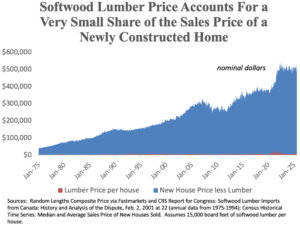
They do not. Lumber is commodity market and prices reflect supply and demand. Over 70 percent of all U.S. housing lumber comes from U.S. producers not subject to duties or tariffs. In the current housing market environment, Canadian companies largely absorb all of the duties paid at the border. Even if they could pass those costs on to the consumer, the overall cost of lumber in an average size house makes up less than two percent of the cost of the house to the consumer. Hence a duty or tariff on a fraction of that lumber (since over 70 percent of all U.S. housing lumber comes from U.S. producers) isn’t even a rounding error in the cost of a new house. One must look elsewhere for a solution to affordability of new home prices. Land cost, labor costs, homebuilder profitability, and the free market reality of homebuilding demand that has boosted many homebuilding input prices. (https://uslumbercoalition.org/resource/high-homebuilder-profits-have-priced-millions-out-of-the-u-s-housing-market/)
On August 1, 2025 the total duties applied to unfairly traded Canadian lumber imports was 14.40 percent. That same month, duties increased to 35.16 percent, and in October President Trump added an additional 10 percent Section 232 tariff. Based on NAHB’s concern and the stated goal of S. 3943, have lumber prices increased by 45.16 percent since then?
Lumber prices initially declined and have largely been flat since August 1, 2025. That is because lumber prices are determined by supply and demand, and not duties or tariffs. There was ample supply in 2025, and Canada rushed to unload its excess lumber supply into the U.S. market. Canadian excess lumber capacity and associated unfair trade practices, such as dumping (selling below their home market sales price or below their cost of production) artificially suppresses normal U.S. lumber prices. While NAHB may applaud this short-term effect, the long-term consequences for U.S. producers, workers, and the United States is devastating. Lost U.S. production, suppressed U.S. capacity, lost U.S. jobs and wages, and a destabilization of the domestically produced lumber supply.

About the U.S. Lumber Coalition
Video: Building American Dreams
The U.S. Lumber Coalition is an alliance of large and small softwood lumber producers from around the country, joined by their employees and woodland owners, working to address Canada’s unfair lumber trade practices. Our goal is to serve as the voice of the American lumber community and effectively address Canada’s unfair softwood lumber trade practices. The Coalition supports the full enforcement of the U.S. trade laws to allow the U.S. industry to invest and grow to its natural size without being impaired by unfairly traded imports. Continued full enforcement of the U.S. trade laws will strengthen domestic supply lines by maximizing long-term domestic production and lumber availability produced by U.S. workers to build U.S. homes. For more information, please visit the Coalition’s website at www.uslumbercoalition.org.